What the DB-HR of the Spanish Building Code regulates, which reverberation limits it sets, which spaces it leaves out and which acoustic data to ask the manufacturer for.
Every building project in Spain has to comply with the DB-HR, the document of the Spanish Building Code (CTE) that regulates protection against noise.
It is a requirement that architects and engineers know well. However, it is not always clear which part of the building's acoustic performance it covers and which part it leaves to the project.
In this article we explain what the DB-HR is, what it requires, what it says about reverberation and where acoustic conditioning comes in for a building that already complies with the standard.
What the DB-HR is
The DB-HR is the Basic Document on Protection against Noise of the Spanish Building Code (Código Técnico de la Edificación). It was approved by Royal Decree 1371/2007 and has been mandatory since 2009.
Its aim is to limit the nuisance that noise can cause to the users of a building. To do so, it sets minimum and maximum values that the project must justify and that can be checked with measurements once the building is finished.
Which buildings it applies to
It applies to new buildings and, with some nuances, to certain works on existing buildings.
There are three cases that the document itself leaves outside its general scope:
- Noisy rooms, such as some plant rooms or leisure venues, which are governed by their own specific regulations.
- Public assembly rooms intended for performances, such as auditoriums, theatres, cinemas or music halls, which require their own acoustic study.
- Classrooms and conference rooms larger than 350 m³, which also need a special acoustic conditioning study.
In other words, the spaces where acoustics are most demanding are not solved by applying a table. They need a tailor-made design.
What the DB-HR requires
Most of the document focuses on preventing noise from passing from one space to another. To that end, it sets several requirements:
- Airborne noise between rooms: it limits how much sound is transmitted through walls and floor slabs. For example, between a protected room, such as a bedroom or an office, and another unit of use, a difference of at least 50 dBA is required.
- Impact noise: it limits the noise of footsteps or knocks coming from the floor above or from an adjoining room. In protected rooms the level cannot exceed 65 dB.
- Outdoor noise: façades have to reduce street noise according to the noise level of the area where the building is located.
- Building services: it limits the noise and vibration generated by lifts, air conditioning and other equipment.
All these requirements relate to the transmission of sound. If you want to look deeper into this distinction, we explain it in our article on the difference between soundproofing and acoustic conditioning.
What the DB-HR says about reverberation
The DB-HR also includes a section on what happens inside the room, although it is shorter and only affects some spaces.
- Classrooms and conference rooms of up to 350 m³: the reverberation time cannot exceed 0.7 s with the room empty and unfurnished, or 0.5 s if the seating is included.
- Restaurants and dining rooms: the reverberation time with the room empty cannot exceed 0.9 s.
- Common areas of residential, educational and hospital buildings that connect with habitable or protected rooms: they must have a minimum absorption of 0.2 m² per m³ of volume.
To justify these values, the reverberation time is calculated using the absorption coefficients of the materials in the room. That is why the test data for each panel are essential in the project.
If you need to brush up on the concept, we explain it in our article on reverberation time.
Which spaces are left out of reverberation control
Outside those cases, the DB-HR sets no limit on how a space sounds inside.
An open-plan office, a meeting room, a hotel reception, a shop or a gym can comply with the Building Code and still have echo, high background noise or problems with speech intelligibility.
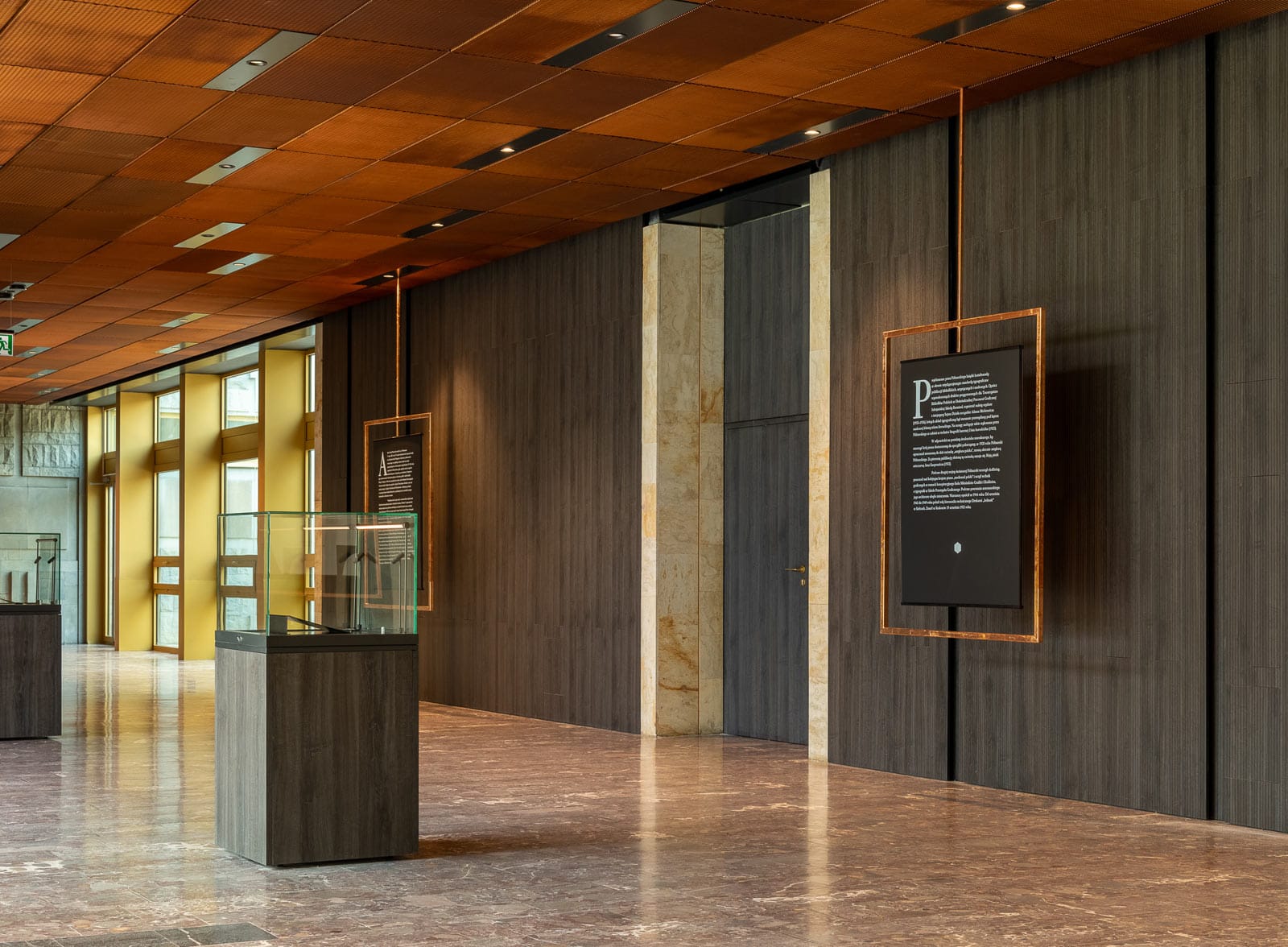
Library reading rooms are another good example. The standard does not set a reverberation time for them, yet they are spaces where concentration depends on sound not building up. At the National Library of Warsaw we installed the Ideacustic Standard 32 system in reading rooms, work areas and common spaces to reduce reverberation without altering the look of a building of great heritage value.
In addition, the limit set by the standard is a minimum. A videoconference room or a classroom where lessons are recorded works better with lower values than those required.
Where acoustic conditioning comes in for a project that already complies with the DB-HR
The DB-HR ensures that the sound in one space does not disturb the spaces next to it. Acoustic conditioning makes sure that each space sounds right for what is going to happen in it.
For example, an office floor with good partitions between offices can have an open-plan area where conversations can be heard from one end to the other. Or a glazed meeting room that complies without any problem, but where video calls come through with echo.
In these cases the work involves choosing where and how much ceiling and wall surface to treat, and with which material. It can also make sense to add acoustic booths for calls or short meetings in open spaces.
Ideally, this should be addressed at the design stage rather than once the building is in use. That way it can be coordinated with lighting, air conditioning and interior design. You can see how we approach it in our article on acoustic conditioning in offices or in the one on how to reduce noise in a restaurant.
Voluntary certifications that do cover it: WELL and LEED
Some building certifications go beyond the Building Code and assess indoor acoustic comfort.
The WELL certification, focused on the health and well-being of occupants, includes a sound section with criteria on reverberation time, absorbent surfaces and background noise levels depending on the type of space.
LEED, more oriented towards sustainability, includes an acoustic performance credit that also takes reverberation into account, and sets minimum requirements for educational buildings.
In projects seeking these certifications, acoustic conditioning becomes a documented requirement and not just a comfort improvement.
What documentation to ask the manufacturer for
To justify compliance with the DB-HR or a certification, and also to compare products, it is worth asking the manufacturer for the following data:
- Laboratory absorption test according to UNE-EN ISO 354, with values per frequency band. These are the values used to calculate the reverberation time.
- Classification according to UNE-EN ISO 11654, with the αw coefficient and the absorption class, from A to E.
- Type of mounting tested, because the same panel can perform differently when fixed directly to the substrate or with an air gap behind it.
- Reaction to fire, with its Euroclass, as required by the Basic Document on Fire Safety.
- Complete technical data sheet, with dimensions, weight and available finishes.
If the test was carried out with a different mounting from the one planned on site, the calculation must take this into account. It is a detail that is often overlooked.
Do you need acoustic data to justify your project?
At Ideatec we provide the technical data sheets for our products with their acoustic tests, and we can help you choose the system and surface area each space needs to comply with the DB-HR or go beyond it.
Talk to our team and we will review the acoustic needs of your project with you.

