

When discussing acoustics in commercial or residential spaces, there is often confusion between soundproofing materials and acoustic treatment materials.
Although both concepts relate to sound control, they serve very different purposes and address different issues. Understanding this difference is key to choosing the right solution for each project.
In this article, we look at what soundproofing materials are, what acoustic treatment materials are, and what their main differences are.
What are soundproofing materials?
Soundproofing materials are designed to block or reduce the transmission of sound between spaces.
In other words, they prevent noise from passing from one room to another or from outside to inside. Their main function is to act as a barrier against sound, reducing its propagation.
How they work
Soundproofing is based on physical principles such as:
- Mass: the higher the density of the material, the greater its ability to dampen sound
- Decoupling: separating structural elements to prevent the transmission of vibrations
- Air-tightness: eliminating cracks, joints or weak points through which sound can seep
These three factors are what truly determine the effectiveness of a soundproofing solution.
Examples of soundproofing materials
- Mineral wool (rock wool or glass fibre)
- Laminated plasterboard in multi-layer systems
- High-density acoustic membranes
- Technical insulation panels
- Acoustic cladding and false ceiling systems
These materials are usually part of more complex construction solutions; they are not used in isolation.
When they are used
- When there is noise between homes or rooms
- In rooms where sound insulation is required (studios, technical rooms, meeting rooms)
- In commercial or industrial premises with high noise levels
- In buildings where compliance with acoustic regulations is required
In these cases, the aim is to significantly reduce sound transmission between spaces.
What are acoustic treatment materials?
Acoustic treatment materials do not block sound, but rather improve the acoustic quality within a space. Their main function is to control reverberation, reduce echo and improve sound intelligibility.
How they work
These materials absorb part of the sound energy, reducing:
- Echo
- Reverberation
- Background noise
This creates a more comfortable environment and allows conversations or sounds to be heard more clearly.
Examples of acoustic treatment materials
When discussing acoustic treatment, it is important to consider the specific materials used, as these are what actually determine the acoustic behaviour of the space.
Among the most common are:
- Glass fibre
- PET (polyester fibre)
- Perforated wood
- Melamine foam
These materials are incorporated into solutions such as:
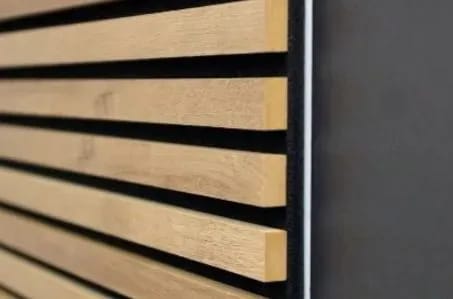
- Decorative acoustic panels
- Suspended acoustic baffles
- Ceiling acoustic islands
- Sound-absorbing cladding
Unlike soundproofing solutions, these are lighter and more flexible to install, allowing for improved acoustic comfort without the need for major works.
When to use them
- Open-plan offices
- Meeting rooms
- Restaurants
- Clinics
- Educational spaces
- Hotels or communal areas
Generally, in any space where the main issue is sound quality rather than sound transmission.
Key technical differences between soundproofing and acoustic treatment
Although both concepts are related, their differences are fundamental:
Main function
- Soundproofing → prevents sound from being transmitted between spaces
- Acoustic treatment → improves sound behaviour within the space
Type of solution
- Soundproofing → structural solutions (building works, multi-layer systems)
- Acoustic treatment → surface solutions (panels, cladding)
Level of intervention
- Soundproofing → requires building work or structural intervention
- Acoustic treatment → quick installation, often without building work
Type of problem they solve
- Soundproofing → noise between spaces
- Acoustic treatment → echo, reverberation, ambient noise
Result
- Soundproofing → actual reduction in sound transmission
- Acoustic treatment → improvement in acoustic comfort
Common mistake: assuming that all acoustic materials provide soundproofing
One of the most common mistakes is assuming that any acoustic material can be used for soundproofing.
For example, installing decorative panels on a wall will not prevent noise from travelling into the adjoining room. In this case, what is being improved is the room’s acoustic treatment, not the insulation.
This mistake is particularly common in offices and commercial spaces, where quick solutions are sought but the problem is not always clearly defined.
How to choose the right solution
To choose correctly between soundproofing and acoustic treatment materials, it is essential to ask yourself a key question:
Is the problem that sound is travelling from one space to another, or that the sound within the space is not suitable?
If the problem is sound transmission
- Soundproofing is required
- More technical and structural solutions
- Greater investment and planning
If the problem is acoustic quality
- Acoustic treatment is required
- Faster and more flexible solutions
- Immediate improvement in comfort
In many cases: a combination of solutions
In professional projects, it is common to combine both strategies to achieve an optimal result.
A key decision in any acoustic project
Soundproofing materials and acoustic treatment materials serve different but complementary purposes.
Choosing the right one not only improves results but also avoids unnecessary expenditure and ineffective solutions. Furthermore, good acoustic planning has a direct impact on the user experience, productivity and the perception of the space.
Therefore, before implementing any solution, it is essential to analyse the nature of the problem and clearly define the project’s objective.