What a sound-absorbing panel is, how it differs from soundproofing panels, what materials are available, and how to choose one based on the space.
Sound-absorbing panels, soundproofing panels, acoustic panels—these terms are often used almost interchangeably, yet they do not refer to the same thing.
Choosing one over the other without a clear understanding of the difference can lead to a solution that fails to address the actual problem within a space. That is why it is best to start with the basics.
What is a sound-absorbing panel?
A sound-absorbing panel is an element that absorbs a portion of the sound it receives, rather than reflecting it. The term itself explains it well: "sound" (fono) and "absorbing"—describing exactly what it does.
These panels are installed on ceilings and walls to reduce reverberation—that is, the persistence of sound within a room after the original sound has been produced.
The effect is noticeable in three ways: speech becomes clearer, the perception of background noise decreases, and the space becomes less fatiguing for those who spend long hours in it.
Why it gets confused with other terms
While all these products relate to noise, they address different issues—which is where the confusion arises.
- Sound-absorbing (fonoabsorbente): Improves the internal sound quality of a room by reducing echo and reverberation.
- Soundproofing (insonorizante): Aims to prevent sound from traveling from one space to another. This depends primarily on mass and the construction of the walls, floors, and ceilings.
- Sound panels: A generic term used for any panel placed on a wall to improve acoustics—whether in a rehearsal studio or an office.
Therefore, a sound-absorbing panel will not prevent you from hearing your neighbor. Conversely, a wall designed to block sound transmission will not stop a meeting room from having an echo.
We explain this in greater detail in our article on the difference between soundproofing and acoustic treatment. If you’d like to start with the basics, here is an overview of what acoustic treatment entails.
What people are actually looking for when they ask for "soundproofing" panels
In practice, many inquiries that use the term "soundproofing" are actually addressing issues related to reverberation.
For example, a restaurant manager who requests "soundproofing" panels because "it’s too noisy" is often dealing with a space characterized by hard surfaces, high ceilings, and many simultaneous conversations. In such cases, the noise is generated and accumulates within the dining area itself. The same applies to an open-plan office where calls can be heard from one end to the other, or to a glass-walled meeting room where video calls suffer from echoes.
In all these cases, the solution lies in the use of sound-absorbing panels. If, however, the issue is that music from a neighboring space or traffic noise from the street can be heard, then structural interventions are required; simply installing ceiling or wall panels will not be enough to solve the problem.
How absorption works
A sound-absorbing panel converts a portion of sound energy into a tiny amount of heat. It achieves this in two ways, and many systems combine both.
By porosity
The material has an open structure with small, interconnected voids. As sound waves enter, the air rubs against the fibers, losing energy in the process.
This is how polyester fiber, fiberglass, and technical fabrics work. The thicker the panel, the more effective it is at addressing low frequencies.
By resonance
This occurs in perforated or slotted panels mounted with an air gap behind them. The air within the perforations vibrates at a specific frequency, dissipating energy within that range.
This allows wood or MDF panels to be tuned to target specific problem areas. They typically feature an acoustic veil on the back, which further enhances absorption.
How it is measured
The key reference metric is the weighted absorption coefficient, αw, which ranges from 0 to 1. Based on this value, products are classified from Class A (the most absorbent) to Class E.
This is the figure to check on a technical data sheet when comparing different panels. If you want to understand how this impacts a room, you may want to look into the concept of "reverberation time."
Sound-absorbing materials manufactured by Ideatec
The material determines the performance, finish, and the type of space for which each panel is suited. These are the product families we offer:
Recycled polyester fiber (PET)
This is the basis of the Ideaflow family. It is lightweight, can be cut to size, and supports suspended configurations such as baffles, islands, or beams.
It is also one of our most highly absorbent materials. Ideaflow baffles have an αw rating of 0.95, corresponding to Class A.
Slotted and perforated MDF
The Ideacustic and Ideaperfo families utilize slotted or perforated MDF panels with an acoustic veil bonded to the back. They function through resonance and are available with wood, melamine, or lacquered finishes.
Performance depends on the slotting pattern. For example, the "Standard 32" pattern has an αw of 0.70 (Class C), while "Pro 11"—featuring finer, more open slots—reaches 0.85 (Class B).
Wood and slats
Within the Ideawood line, Idealux FL combines MDF slats with a polyester fiber backing. It provides a continuous wood finish and an αw rating of 0.95.
Textile
The Ideafabric family consists of panels with an absorbent core covered in technical fabric. This option offers the widest range of color possibilities, allowing panels to either blend in discreetly or serve as a decorative feature.
How to Choose Sound-Absorbing Panels Based on Space Usage
There is no single panel that works for every situation. The right choice depends on the activity, the volume of the room, and the aesthetic finish required by the project.
Offices and Meeting Rooms
In open-plan spaces, treating the ceiling with suspended elements—such as baffles or acoustic islands—often works well, complemented by wall panels in designated work areas.
In meeting rooms, it is advisable to treat at least one of two opposing walls to prevent echoes. And when phone calls become an issue in an open-plan environment, Ideazone acoustic pods provide a private space without the need for construction work.
Restaurants and Hospitality
In these settings, the ceiling is usually the priority surface; it offers the largest area and interferes the least with the interior design. Furthermore, it is essential to select materials that are easy to maintain.
Classrooms, Auditoriums, and Conference Rooms
In these spaces, speech intelligibility is the primary concern. In some cases, building codes also specify a maximum reverberation time, meaning the choice of material must be supported by technical calculations.
Hotels and Representative Spaces
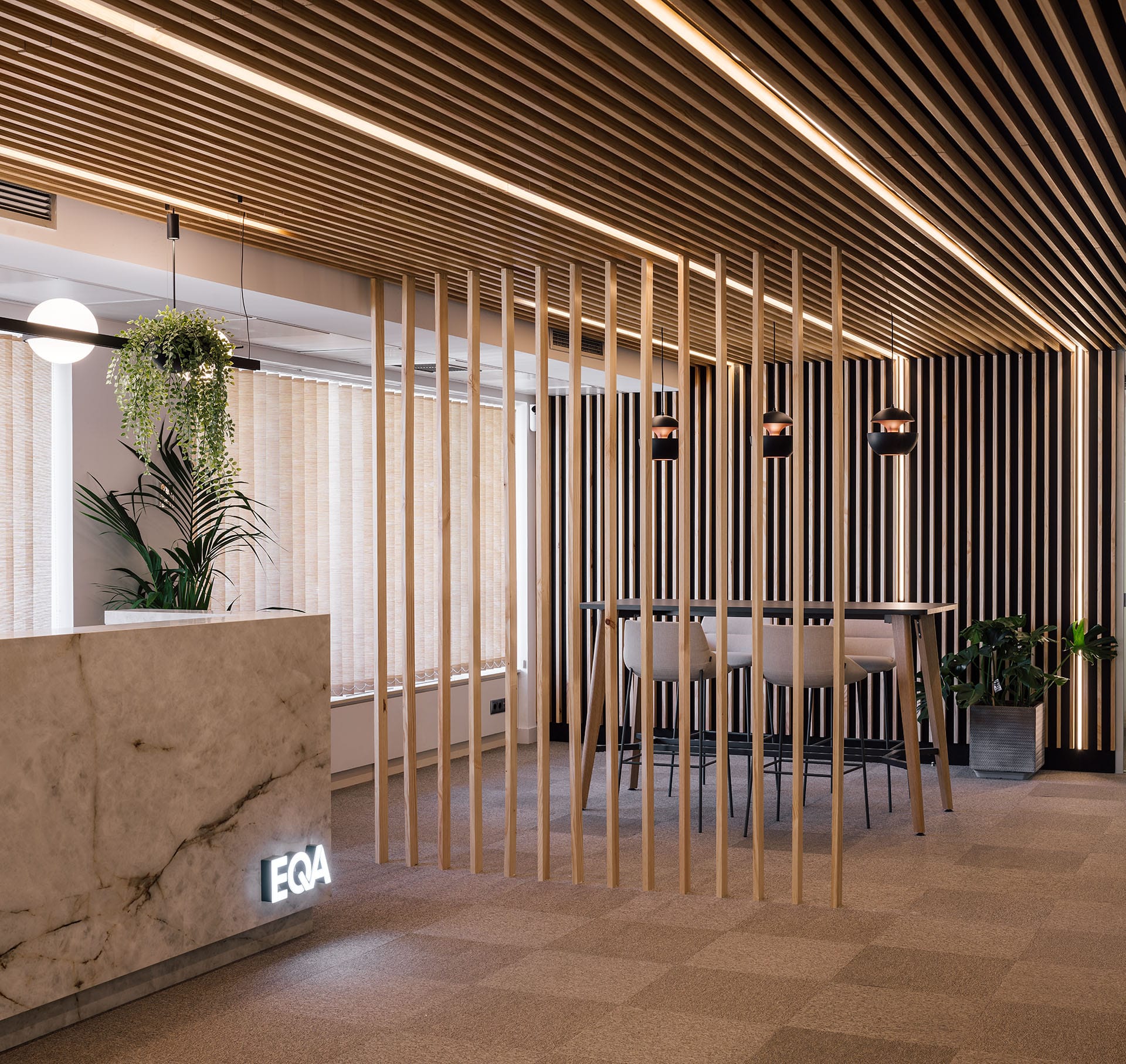
When the aesthetic finish is just as important as acoustic performance, grooved wood panels or slats allow for the integration of acoustics into the interior design, ensuring they do not appear as mere technical add-ons.
Two Real-World Projects
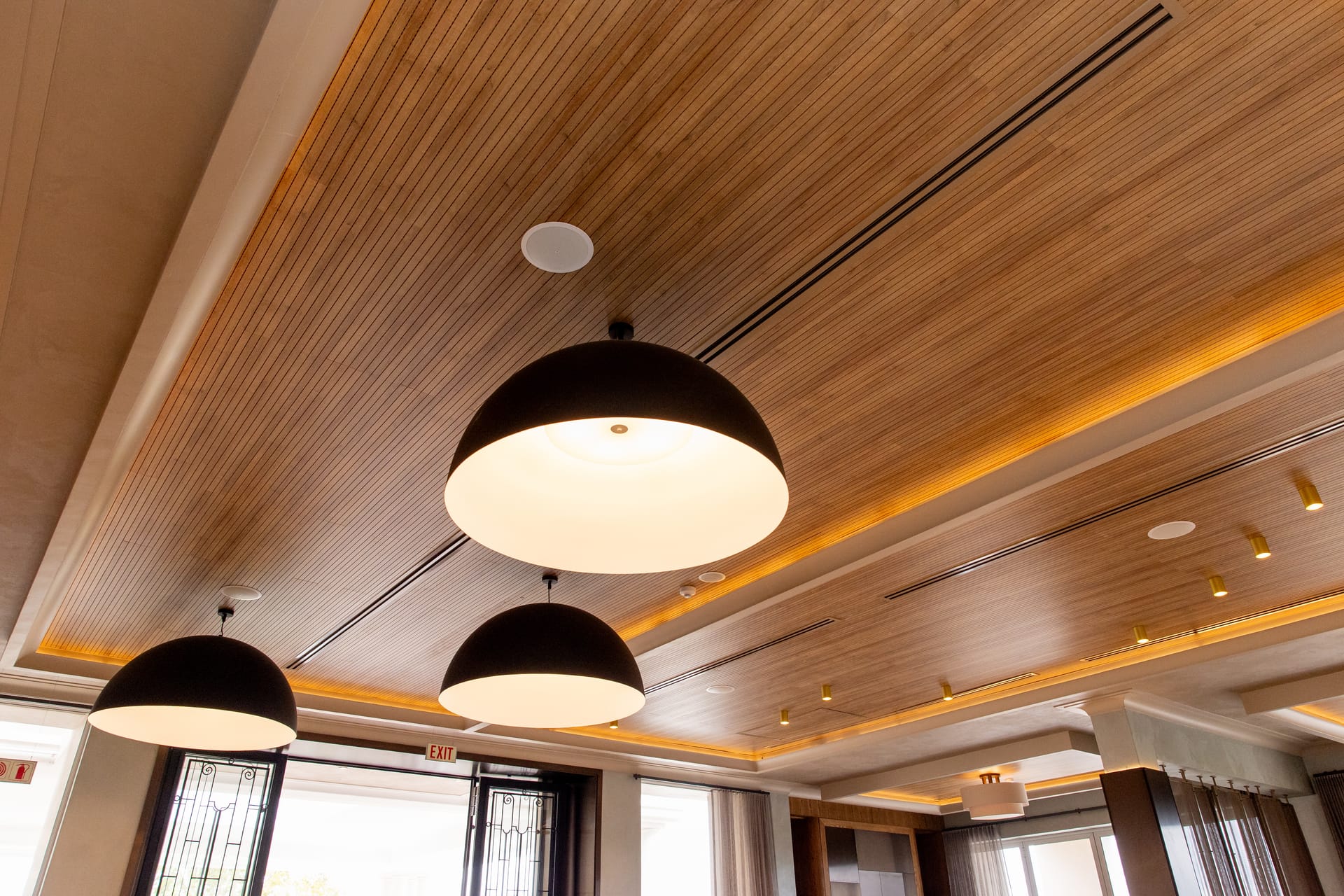
At the Four Seasons Hotel Johannesburg, the "Standard 32" system was installed to reduce reverberation in common areas, restaurants, and lounges. The goal was to control sound reflections and improve communication in shared spaces, all while maintaining the high-end finish expected of a luxury hotel.
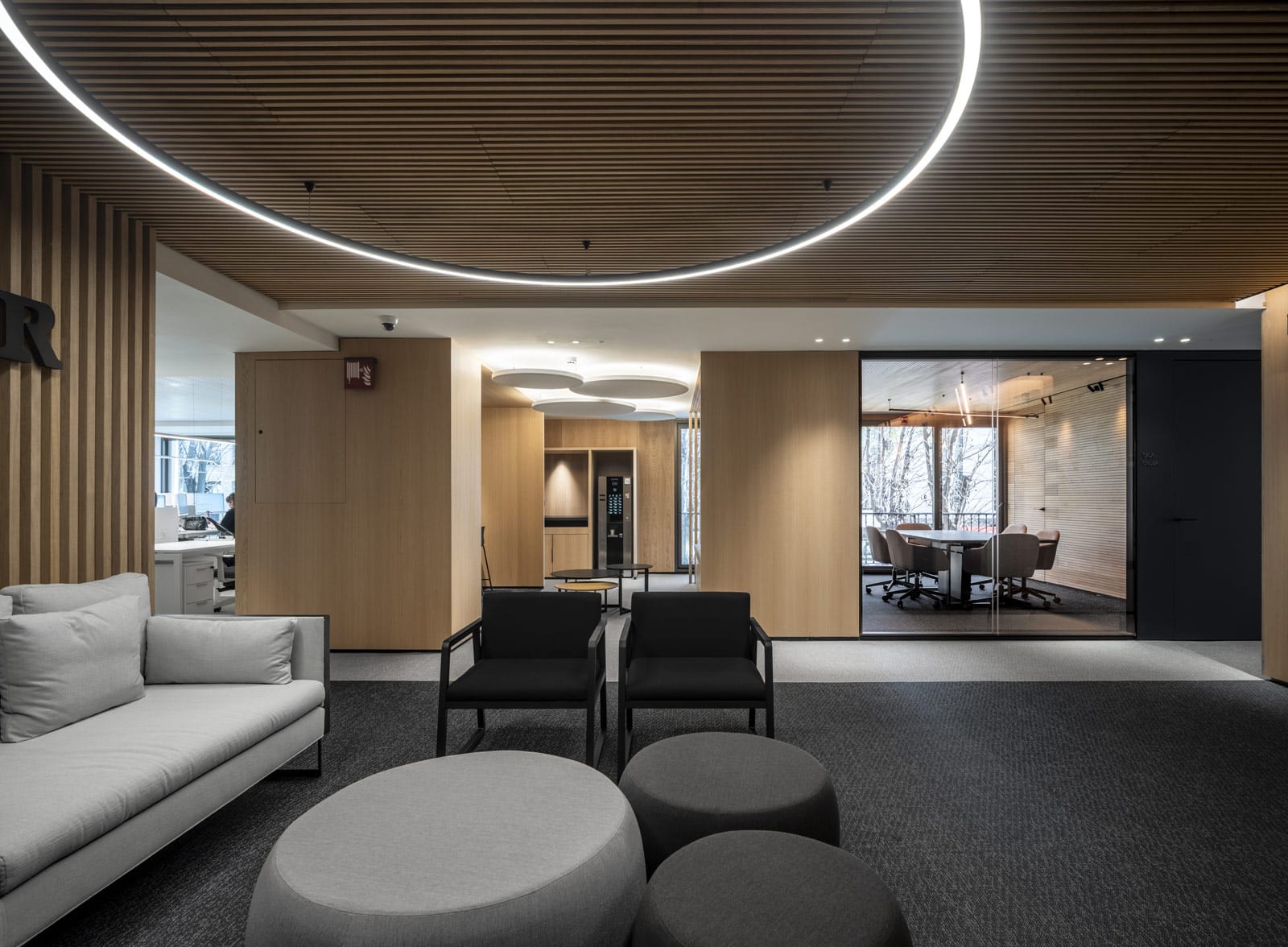
At the Caja Rural headquarters in Seville, the same system was used in a corporate building featuring open-plan areas, meeting rooms, and circulation zones. The architectural project was designed by Estudio Baum Arquitectura, with installation carried out by Carpintería Alberto Pigner.
In both cases, the panels serve a dual purpose: they absorb sound while also contributing to the visual language of the space.
Are you looking for sound-absorbing panels for your project?
At Ideatec, we manufacture sound-absorbing panels for ceilings and walls, crafted from materials such as recycled polyester fiber, MDF, wood, and textiles. Each solution is tailored to the specific application, the volume of the room, and the finish required for your project.
Consult with our team, and we will help you select the right panel and surface for your space.

