

At Ideatec, we’ll introduce you to room acoustics and noise maps – key factors to consider when minimising noise in a room as much as possible.
Environmental acoustics and noise maps
Acoustics is a branch of physics that studies the sounds, infrasound and ultrasound that propagate through matter. It examines the production, transmission and absorption of sound, as well as its perception and reproduction.
Within this branch of physics lies environmental acoustics, which studies outdoor sound, environmental noise and its effects on people and nature. It also examines sources of noise such as traffic, aeroplanes, trains, ships, factories, and environments where noise is generated, such as workshops, as well as leisure venues, stadiums or even parks, for example.
What are noise maps?
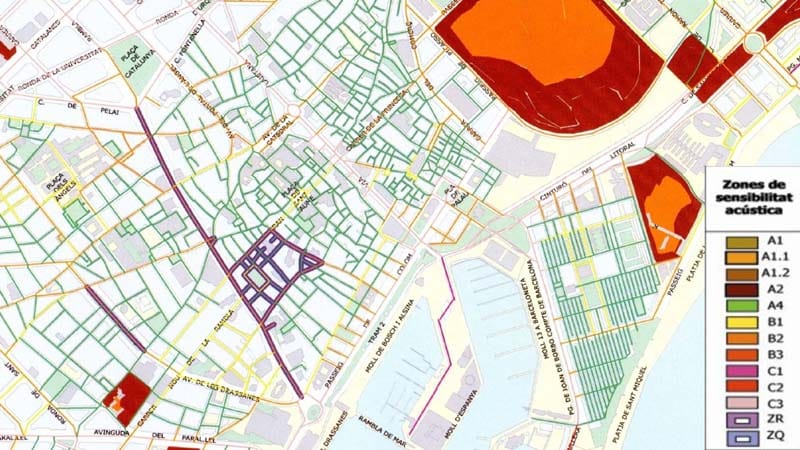
One of the tasks carried out in the field of environmental acoustics is the creation of noise maps, which provide a cartographic representation of noise levels in a given area. This makes it possible to determine the noise level or levels to which a particular group of people is exposed.
Thanks to this information, various plans and strategies can be developed, the primary aim of which is to prevent and reduce environmental noise, particularly when noise levels may become harmful to health.
Provided that all the data collected during the study is interpreted correctly, it is possible to distinguish between different measurement ranges, thereby identifying the main sources of noise pollution so that they can be reduced through an appropriate strategy.
If we look at how noise is represented on a map of this kind, it can be identified in various ways, using isophones and colours. Isophones are lines connecting points where sound pressure levels are the same. Points where the sound pressure level is the same are represented by the same colour.
These types of maps are produced in two ways: one through sampling and the other through simulation. In the latter case, a technique is used to digitise noise levels using a sound level meter. This is a device capable of measuring noise pollution in large areas, and the study is conducted at different times over specific periods to obtain acoustic references from which reliable data can be derived.
To produce these maps, noise sources must be identified, as this is necessary to take appropriate measures. In this case, two strategies are used: one involves noise level maps, which measure noise density. On the other hand, noise exposure maps focus directly on assessing buildings and homes exposed to various noise levels.
We must not overlook the importance of producing noise maps that are as accurate as possible, as this is essential for taking action to combat noise, aiming to reduce it as much as possible, with the benefits that this brings.