Discover what sound absorption is, how sound-absorbing materials work, what α, αw, NRC and absorption classes A to E mean, and how to interpret an acoustic panel’s technical data sheet.
Acoustic panel technical data sheets often include values such as αw = 0.85, NRC = 0.90 or Class B. These indicate how much sound each material absorbs, but understanding how to interpret them is not always straightforward.
Two panels with a similar appearance can have very different acoustic performance. Likewise, the same value can lead to different conclusions if you do not know how it was measured.
In this article, we explain what sound absorption is, how sound-absorbing materials work, how acoustic absorption is measured and which materials absorb sound most effectively, using examples from actual technical data sheets in our product catalogue.
What is sound absorption?
Sound absorption is the ability of a material to absorb part of the sound energy that reaches it, rather than reflecting it back into the room.
When a sound wave hits a surface, part of its energy is reflected, part is absorbed and, in some cases, part passes through the material. A sound-absorbing material minimises the amount of reflected sound.
This energy does not disappear. It is converted into a very small amount of heat through friction between the air and the material's fibres or through the vibration of its components.
What happens to sound that is not absorbed?
Sound that is not absorbed is reflected and continues to travel around the room. It bounces from one surface to another until it loses all its energy.
These reflections are what cause reverberation: sound persists after it has been emitted and overlaps with subsequent sounds. Excessive reverberation reduces speech intelligibility and increases the perception of noise.
This is why sound absorption is the primary tool in acoustic treatment.
Sound absorption is not the same as sound insulation
A highly absorbent material improves the acoustic conditions within a room, but it does not necessarily prevent sound from reaching an adjacent room. To achieve this, the construction of walls, floors and ceilings must be addressed.
We explain this difference in our article on sound-absorbing panels.
How do materials absorb sound?
Not all materials absorb sound in the same way. There are three main sound absorption mechanisms, and many acoustic panels combine more than one.
Porous absorption
Porous materials have an open structure containing small, interconnected cavities. When sound enters the material, friction between the air and the fibres dissipates sound energy.
This is how polyester fibre, glass fibre, mineral wool and technical textiles work. They are particularly effective at absorbing mid and high frequencies, which are important for speech intelligibility.
To absorb low frequencies effectively, these materials require greater thickness or an air cavity behind them. This is why the same material can deliver different acoustic performance depending on how it is installed.
Resonant absorption
Resonant absorption occurs in slotted or perforated acoustic panels installed with an air cavity behind them. The air within each slot or perforation, together with the air inside the cavity, forms a small resonator that dissipates energy within a specific frequency range.
By adjusting the spacing between slots, the diameter of the perforations or the depth of the air cavity, the frequency range in which the panel operates can be modified. These panels usually incorporate an acoustic fleece backing that helps broaden this absorption range.
Membrane absorption
A thin, lightweight panel installed over a sealed air cavity can vibrate like a membrane when exposed to sound. This vibration dissipates energy, particularly at low frequencies.
This mechanism is less common in decorative acoustic panels but is useful in spaces where low-frequency sound is a concern, such as certain auditoriums or music rooms.
How is sound absorption measured?
Sound absorption is measured in a laboratory using a reverberation chamber in accordance with the UNE-EN ISO 354 standard. Several acoustic performance indicators are obtained from these measurements, each serving a different purpose.
Sound absorption coefficient (α)
The sound absorption coefficient indicates the proportion of incident sound energy absorbed by a material. Its theoretical value ranges from 0 to 1.
A value of 0 means that the material reflects all the sound, while a value of 1 means that it absorbs all the sound. An α value of 0.70 indicates that the material absorbs 70% of the incident sound energy at that frequency.
This coefficient varies depending on the frequency. For this reason, acoustic tests measure absorption across frequency bands, typically from 125 to 4,000 Hz when presenting octave-band results.
Weighted sound absorption coefficient (αw)
The αw value summarises the acoustic absorption performance of a material in a single figure. It is calculated in accordance with the UNE-EN ISO 11654 standard by comparing absorption values across frequency bands with a reference curve.
It is the most widely used indicator in Europe for comparing acoustic panels. One important consideration is that poor absorption in certain frequency bands can reduce the αw value, even if the material performs very well at other frequencies.
Sound absorption classes A to E
Based on the αw value, the same standard categorises materials into five sound absorption classes:
- Class A: αw between 0.90 and 1.00.
- Class B: αw between 0.80 and 0.85.
- Class C: αw between 0.60 and 0.75.
- Class D: αw between 0.30 and 0.55.
- Class E: αw between 0.15 and 0.25.
Materials with an αw below 0.15 are considered unclassified. The absorption class is useful for an initial comparison, but it should not replace a detailed assessment of the acoustic performance data.
NRC and αm
The NRC, or Noise Reduction Coefficient, is the average sound absorption coefficient across the 250, 500, 1,000 and 2,000 Hz frequency bands, rounded to the nearest 0.05. It is primarily used in North American product catalogues.
Some technical data sheets also include αm, an arithmetic mean of the absorption coefficients across specified frequency bands. As this indicator does not penalise weaker frequency bands in the same way as αw, its value is often equal to or higher than αw.
Equivalent sound absorption area
To determine how much acoustic treatment will affect a room, the sound absorption coefficient is multiplied by the installed surface area. The result is the equivalent sound absorption area, expressed in square metres of equivalent absorption (metric sabins).
For example, 20 m² of acoustic panels with an α value of 0.85 provide an equivalent absorption area of 17 m² of perfectly absorbing surface.
Using this information together with the room volume, it is possible to estimate the reverberation time, as explained in our article on RT60 and reverberation time.
Which materials absorb sound most effectively?
There is no single material that offers the best sound absorption in every situation. Acoustic performance depends on frequency, thickness, installation method and the total surface area treated. Nevertheless, there are clear differences between material categories.
Polyester fibre (PET)
Polyester fibre is a material capable of delivering high sound absorption with relatively low thickness. It is lightweight, can be cut to size and is suitable for suspended acoustic solutions.
For example, Ideaflow baffles made from 18 mm polyester fibre achieve an αw of 0.95 (Class A) and an NRC of 0.91, according to the product data provided. Double PET panels also achieve an αw of 0.95.
Wood with sound-absorbing backing
Wooden slats alone provide limited sound absorption, as wood is a relatively reflective material. Their acoustic performance largely depends on the material installed behind them.
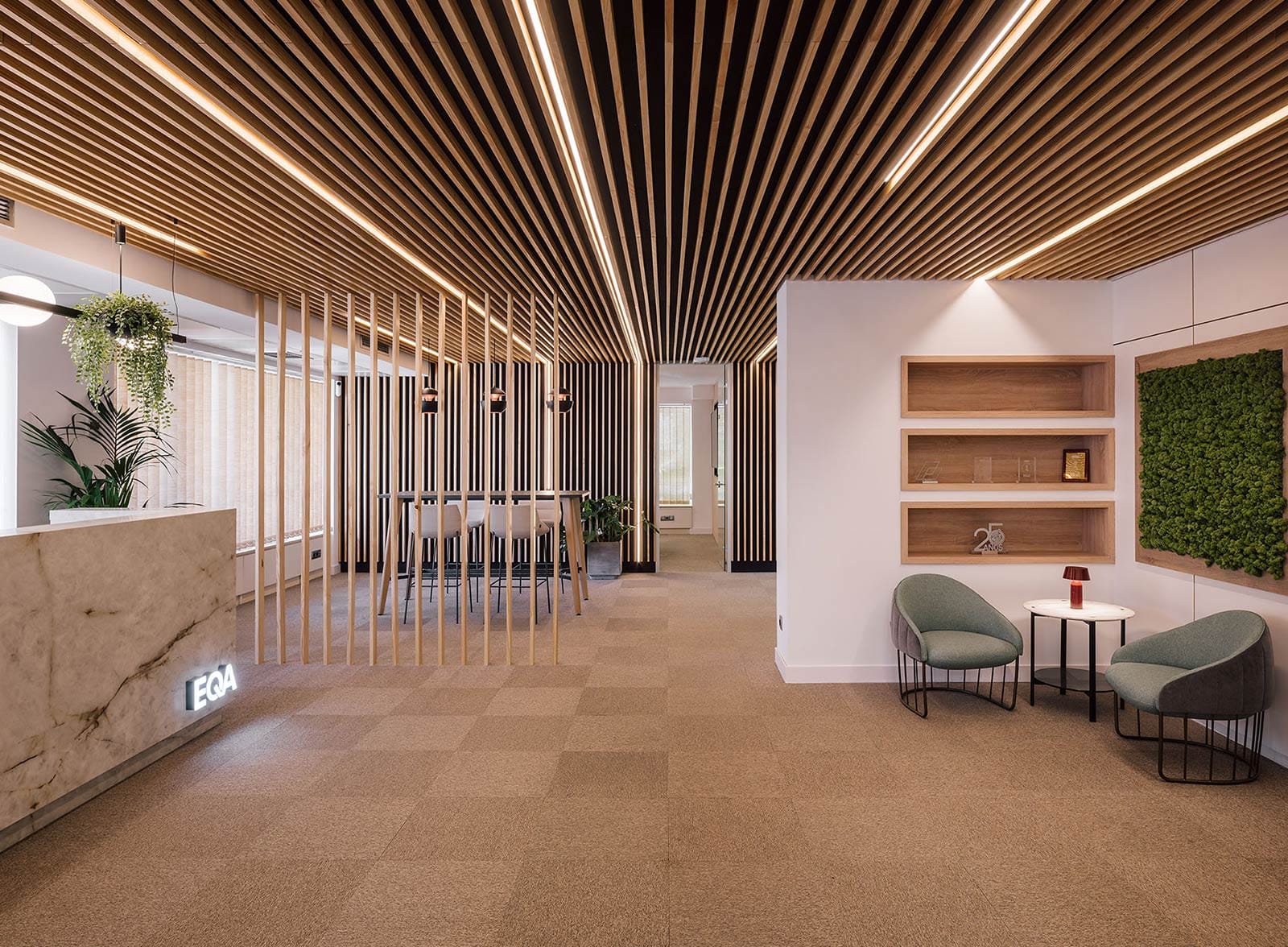
Idealux FL, which combines MDF slats with a polyester fibre backing, achieves an αw of 0.95. By comparison, a Slats system achieves an αw of 0.40 (Class D).
Slotted and perforated MDF
Slotted and perforated MDF panels work through resonant absorption and incorporate an acoustic fleece backing. The slot or perforation pattern plays a key role in determining their acoustic performance.
Ideacustic Pro 11, with 11 mm spacing between slots, achieves an αw of 0.85 (Class B). Ideacustic Standard 32, with 32 mm spacing between slots, achieves an αw of 0.70 (Class C). Microperforated panels such as Ideaperfo Micro 05 offer an almost seamless appearance with an αw of 0.60.
Fabric-covered glass fibre panels
Fabric-covered acoustic panels with a glass fibre core are highly effective at absorbing mid and high frequencies, while offering considerable flexibility in terms of colour and design.
Fibertex, from the Ideafabric range, is a good example of why it is important to review the entire technical data sheet. It has an αm of 0.90 and an NRC of 0.75, but an αw of 0.55. It provides high sound absorption at speech frequencies and lower absorption at low frequencies, which reduces its weighted sound absorption coefficient.
How to read an acoustic panel's technical data sheet
Before comparing two acoustic panels, we recommend reviewing the following information in their technical data sheets:
- αw and absorption class: the reference indicators for comparing acoustic products in Europe.
- αm or NRC: these provide additional information about the material's absorption performance across frequency bands relevant to speech.
- Frequency absorption curve: indicates the frequencies at which the material performs best, when available.
- Panel thickness and test installation method: the same panel can achieve different absorption values depending on whether it is installed with or without an air cavity.
- Reaction to fire: in many applications, fire classification determines which materials can be installed.
An acoustic panel with a very high αw is not always the best option. In a meeting room, where speech is the main source of noise, a material with high absorption at mid frequencies can perform very effectively, even if its αw is not the highest.
Examples using actual acoustic performance data from our catalogue
Based on the technical data sheets in our product catalogue, the following comparison illustrates the acoustic performance of several panels:
- Ideaflow Baffles: αw 0.95, Class A, NRC 0.91.
- Idealux FL: αw 0.95, Class A, NRC 0.88.
- Ideacustic Pro 11: αw 0.85, Class B, NRC 0.90.
- Ideacustic Standard 32: αw 0.70, Class C, NRC 0.65.
- Ideaperfo Micro 05: αw 0.60, Class C, NRC 0.75.
- Fibertex: αw 0.55, Class D, NRC 0.75.
- Slats wooden slat system: αw 0.40, Class D, NRC 0.45.
In practice, the most suitable acoustic product is selected by combining these performance indicators with the aesthetic and material requirements of each project.
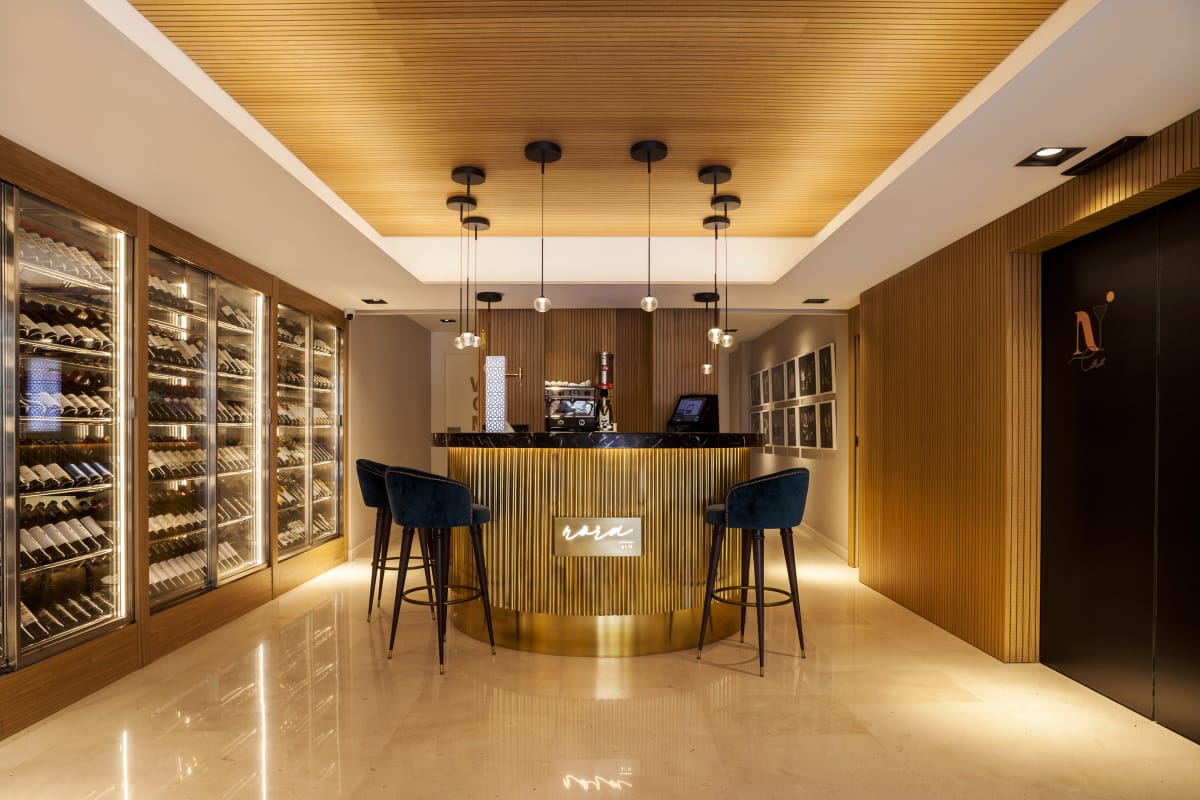
At Club Nora in Barcelona, Ideacustic Standard 32 was installed on ceilings and walls to control reverberation in the restaurant while maintaining a continuous wood finish.
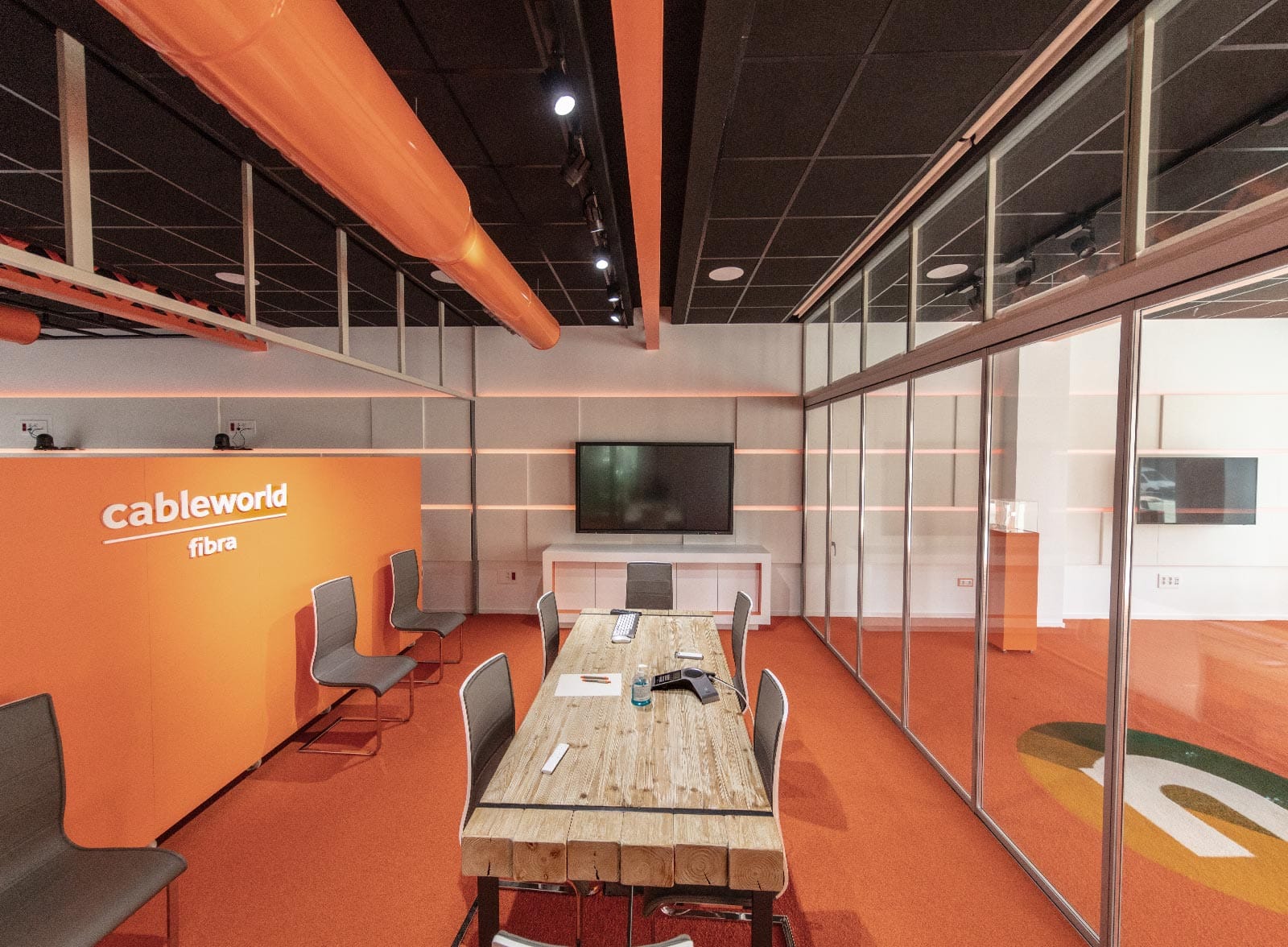
At the Cableworld offices in Novelda, Fibertex was used to improve speech intelligibility in workspaces and meeting areas.
What to consider before choosing acoustic panels
The sound absorption performance of a panel is only one part of the calculation. We also recommend considering the following factors:
- Room volume and target reverberation time.
- Available surface area for acoustic treatment: the amount of acoustic panelling installed is just as important as the choice of product.
- The intended use of the space: speech, music or activities with high levels of background noise.
- The design requirements of the project and anticipated maintenance needs.
Based on these factors, it is possible to calculate how many square metres of each material are required and where they should be installed to achieve optimal acoustic performance.
Do you need to calculate the sound absorption requirements for your project?
At Ideatec, we manufacture acoustic panels in PET, wood, slotted and perforated MDF, and textile finishes, with sound absorption test results published in each product's technical data sheet.
Contact our team and we will help you select the right materials and determine the amount of acoustic treatment your space requires.

