What the Lombard effect is, why it causes us to raise our voices in noisy restaurants and offices, and how it can be mitigated by reducing the room's reverberation
A restaurant opens with its dining area half full, and conversations flow naturally. An hour later, with every table occupied, it becomes difficult to hear the person sitting opposite, and everyone is speaking considerably louder than before.
No one has consciously decided to raise their voice. It is an automatic response known as the Lombard effect.
In this article, we explain what the Lombard effect is, why it is more pronounced in certain indoor spaces, how it affects acoustic comfort and speech intelligibility, and how effective acoustic treatment can help break this cycle of increasing noise levels.
What is the Lombard effect?
The Lombard effect is the involuntary tendency to raise our voices in the presence of background noise. When speaking in a noisy environment, we automatically increase our vocal volume to maintain speech intelligibility, often without realising it.
The phenomenon is named after Étienne Lombard, a French otolaryngologist who first described it in the early 20th century. He observed that his patients spoke louder when exposed to noise through their ears and returned to their normal speaking volume as soon as the noise disappeared.
However, the Lombard effect is not just about volume. When speaking in noisy environments, vowel sounds become longer, vocal pitch increases and articulation becomes more pronounced. It is the body's natural response to ensure that the message is understood.
Why the Lombard effect intensifies in certain rooms: the noise feedback loop
In a room with excessive reverberation, the Lombard effect goes beyond an individual raising their voice. It develops into a self-reinforcing cycle of increasing noise levels.
The process typically follows four steps:
- Step one: Several tables engage in conversations simultaneously, and sound reflects off floors, ceilings, walls and glass surfaces.
- Step two: These sound reflections accumulate, increasing background noise levels.
- Step three: To maintain speech intelligibility, people at each table begin speaking slightly louder.
- Step four: These louder voices generate further sound reflections, increasing background noise levels once again.
The result is an indoor environment where sound levels increase as more people enter, disproportionately to the number of occupants.
This is why the problem does not depend solely on how many people are in a room. Above all, it depends on how long sound continues to reflect before fading away, which is measured by reverberation time. We explain this in more detail in our article on RT60 and reverberation time.
What causes excessive reverberation in a room?
Spaces that are particularly susceptible to this noise feedback loop tend to share several characteristics:
- Hard surfaces: Concrete, stone, ceramic, glass and metal reflect most of the sound that reaches them.
- High ceilings and large room volumes: Sound takes longer to lose energy and dissipate.
- Limited soft furnishings: Without curtains, upholstery or textiles, there are few elements to absorb sound reflections.
- Multiple simultaneous sound sources: Conversations, cutlery, coffee machines and telephones contribute to overall noise levels.
These are precisely the characteristics commonly found in contemporary interior design: open-plan spaces, premium materials and clean, minimalist finishes.
How much does vocal volume increase due to the Lombard effect?
A quiet conversation between two people standing one metre apart typically measures around 60 decibels (dB). This is an approximate reference, as every voice and situation is different.
In the presence of background noise, vocal volume increases progressively. Studies on the Lombard effect generally estimate an increase of approximately half a decibel in vocal level for every additional decibel of background noise, once noise begins to interfere with conversation.
This may seem insignificant, but in a fully occupied dining area, dozens of voices are becoming louder simultaneously, contributing to an overall increase in sound levels.
Where is the Lombard effect most noticeable?
The Lombard effect occurs in any environment with background noise, but it is particularly noticeable in certain types of indoor spaces.
Restaurants, bars and cafés
Hospitality environments are among the most recognisable examples of the Lombard effect. Multiple simultaneous conversations, hard surfaces and limited separation between tables create challenging acoustic conditions.
Furthermore, conversations are not the only source of noise in hospitality spaces. Open kitchens, bar areas, background music and moving chairs also contribute to background noise levels, causing customers to raise their voices even further to understand one another.
Open-plan offices
In an open-plan office, a telephone call or a conversation between two colleagues can be heard across much of the workspace. People on the phone raise their voices to be heard above surrounding noise, gradually increasing the overall sound level.
Glazed meeting rooms present a similar acoustic challenge. Highly reflective surfaces cause speech to reverberate, while poor acoustic conditions during video calls encourage participants to speak louder.
School dining halls, classrooms and waiting areas
School and workplace canteens, classrooms, gyms and waiting areas bring large numbers of people together in spacious environments. These spaces often feature easy-to-clean materials, which also tend to be highly reflective, contributing to excessive reverberation and reduced acoustic comfort.
What are the consequences of the Lombard effect?
The Lombard effect is not simply a matter of acoustic comfort. It has consequences for both the people using a space and those working in it.
Vocal fatigue and tiredness
Speaking loudly for extended periods causes vocal fatigue. This particularly affects waiting staff, customer service professionals, teachers and employees who spend much of their working day on the phone.
It also increases overall fatigue. Following a conversation in the presence of background noise requires constant concentration, and this additional effort accumulates throughout the day.
Reduced speech privacy
When everyone speaks louder, conversations can be heard from further away. In office environments, this affects client calls and meetings involving sensitive information.
The same happens in restaurants. Conversations at neighbouring tables are no longer perceived as background murmurs but become clearly intelligible.
Poorer customer experience
A noisy dining area can make a meal less enjoyable, encourage customers to spend less time at the table or lead some guests to avoid the restaurant during peak hours.
In our article on how to reduce noise in restaurants, we explore how excessive noise affects the customer experience in hospitality environments and which acoustic solutions can help.
Workplace noise
Most offices and restaurants do not reach the noise levels considered hazardous to hearing under occupational health and safety regulations. In Spain, Royal Decree 286/2006 establishes the lower exposure action value at 80 decibels (dB) of daily noise exposure.
However, remaining below this threshold does not mean that noise has no impact. Even at lower levels, background noise continues to affect concentration, stress and fatigue.
How to break the Lombard effect cycle
Simply asking people to speak more quietly is not an effective solution. The Lombard effect is an involuntary response, so the solution lies in improving the room acoustics.
The most effective measure is to reduce reverberation, allowing sound to dissipate more quickly and preventing it from accumulating. If background noise levels remain under control, people do not need to raise their voices as much, breaking the noise feedback loop.
Ceiling sound absorption
The ceiling is usually the largest unobstructed surface in a room and the one that interferes least with the functionality of the space. For this reason, it is generally the first surface to consider when implementing acoustic treatment.
It can be treated with suspended acoustic panel ceilings or suspended elements such as Ideaflow polyester fibre baffles, particularly when the original ceiling features exposed building services or needs to remain untouched.
Wall sound absorption
Parallel, opposing walls generate repeated sound reflections that increase reverberation time. Treating at least one of these surfaces helps interrupt these reflections.
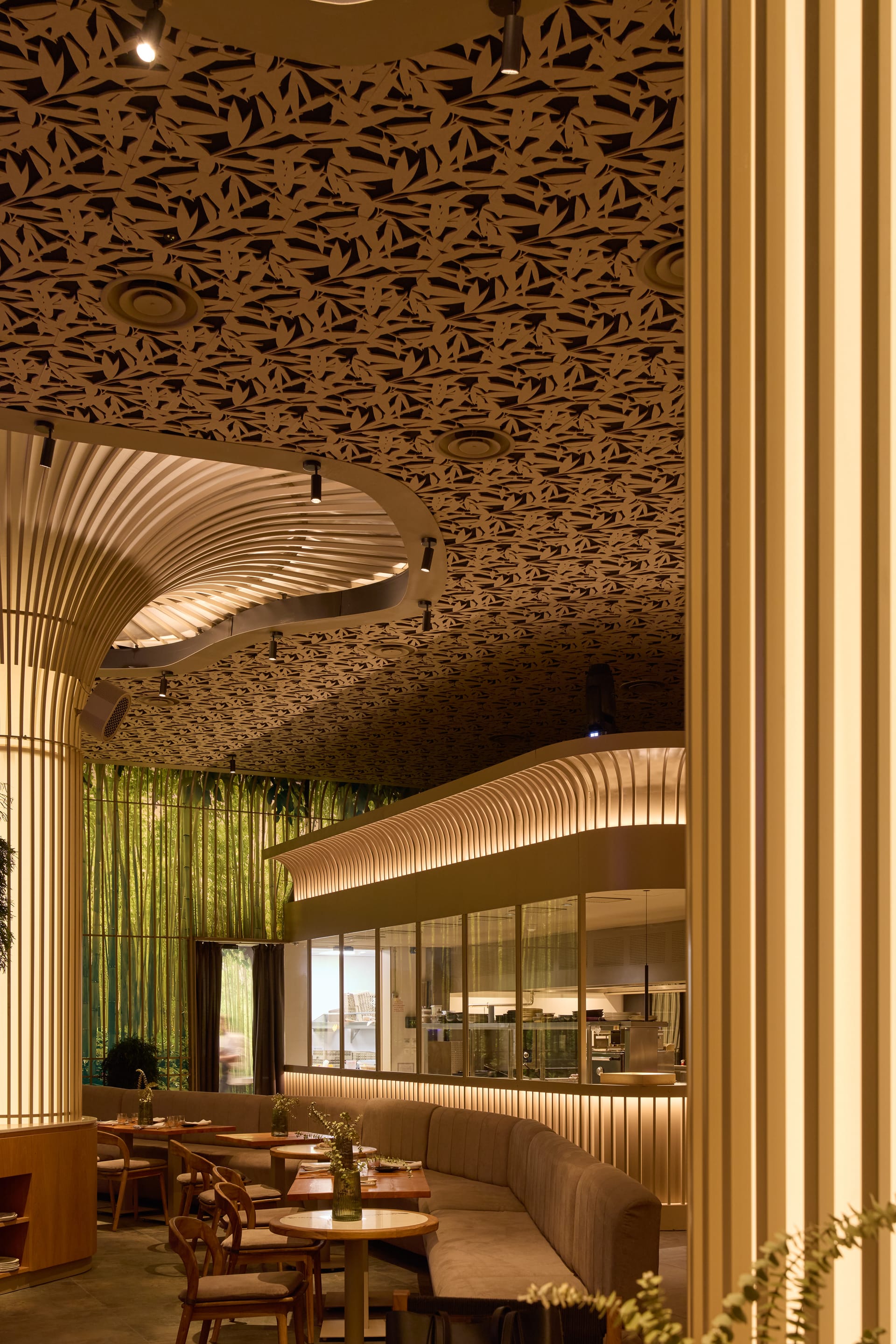
In hospitality environments, ceiling acoustic treatment is often combined with slotted acoustic wall coverings, such as Ideacustic Standard 32, or custom-designed PET acoustic panels, such as Double PET panels.
The amount of acoustic treatment matters as much as the product
Acoustic performance depends on both the material and the total surface area treated. Even a highly absorbent acoustic panel covering just one isolated square metre of a room will have little impact on its overall acoustic conditions.
That is why we recommend assessing the room volume, its intended use and the target reverberation time before calculating the required acoustic panel coverage and determining the most effective placement.
Separating noise sources
In addition to sound absorption, effective space planning can help reduce noise levels. Positioning quieter areas away from the bar or kitchen in a restaurant, or creating dedicated areas for telephone calls in an office, helps reduce initial background noise levels.
In open-plan offices, acoustic booths provide dedicated spaces for telephone calls and video conferences, removing one of the most persistent sources of noise from the shared workspace.
Acoustic treatment examples in restaurants and offices
At Forja Restaurant in Manises (Valencia, Spain), custom-designed Double PET acoustic panels were installed. The solution reduces reverberation in the dining area while forming an integral part of the restaurant's interior design.
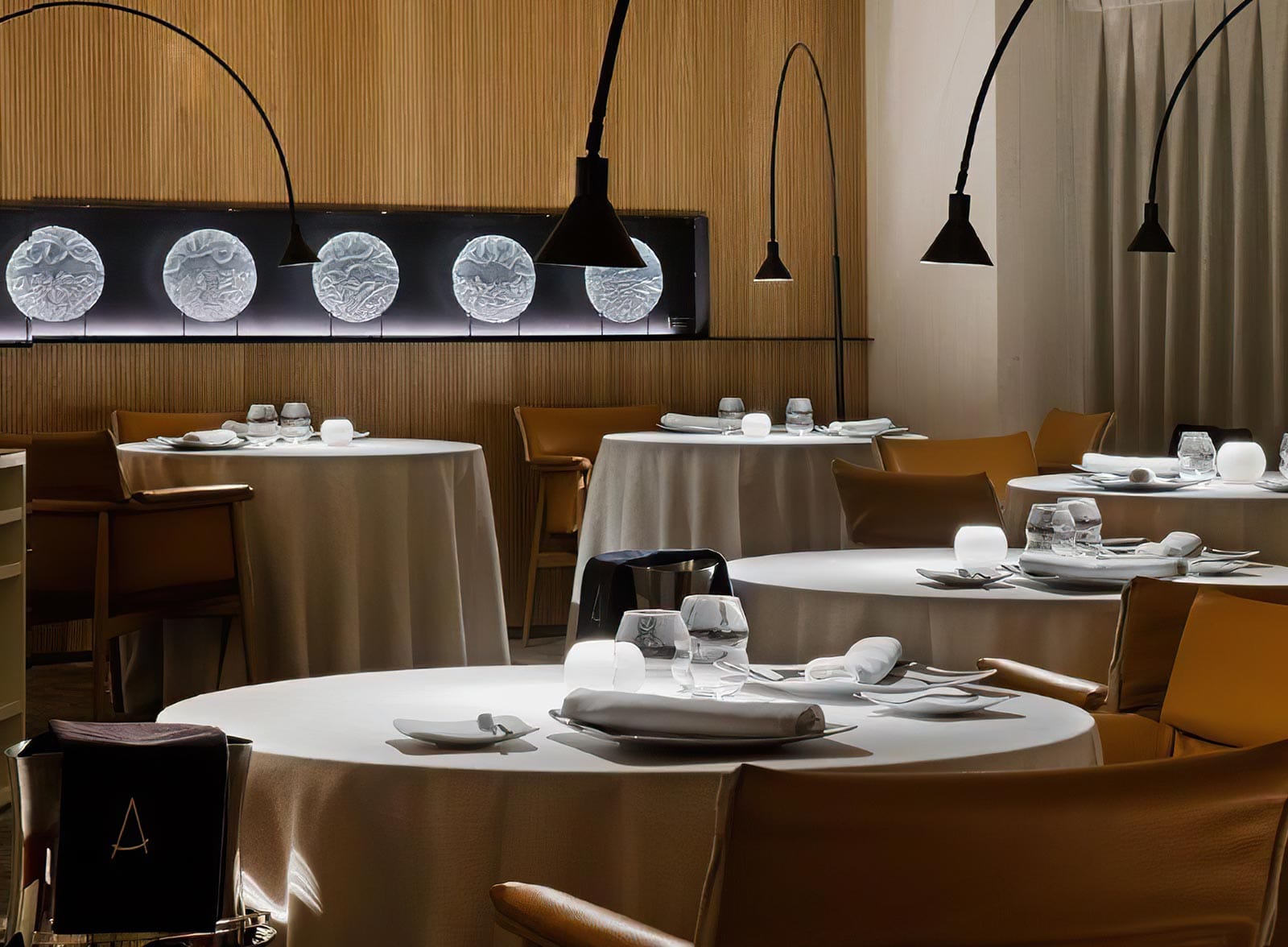
At Angle Restaurant, located within Hotel Cram in Barcelona, Ideacustic High 16 was used to control reverberation in a fine dining environment without compromising its aesthetics.
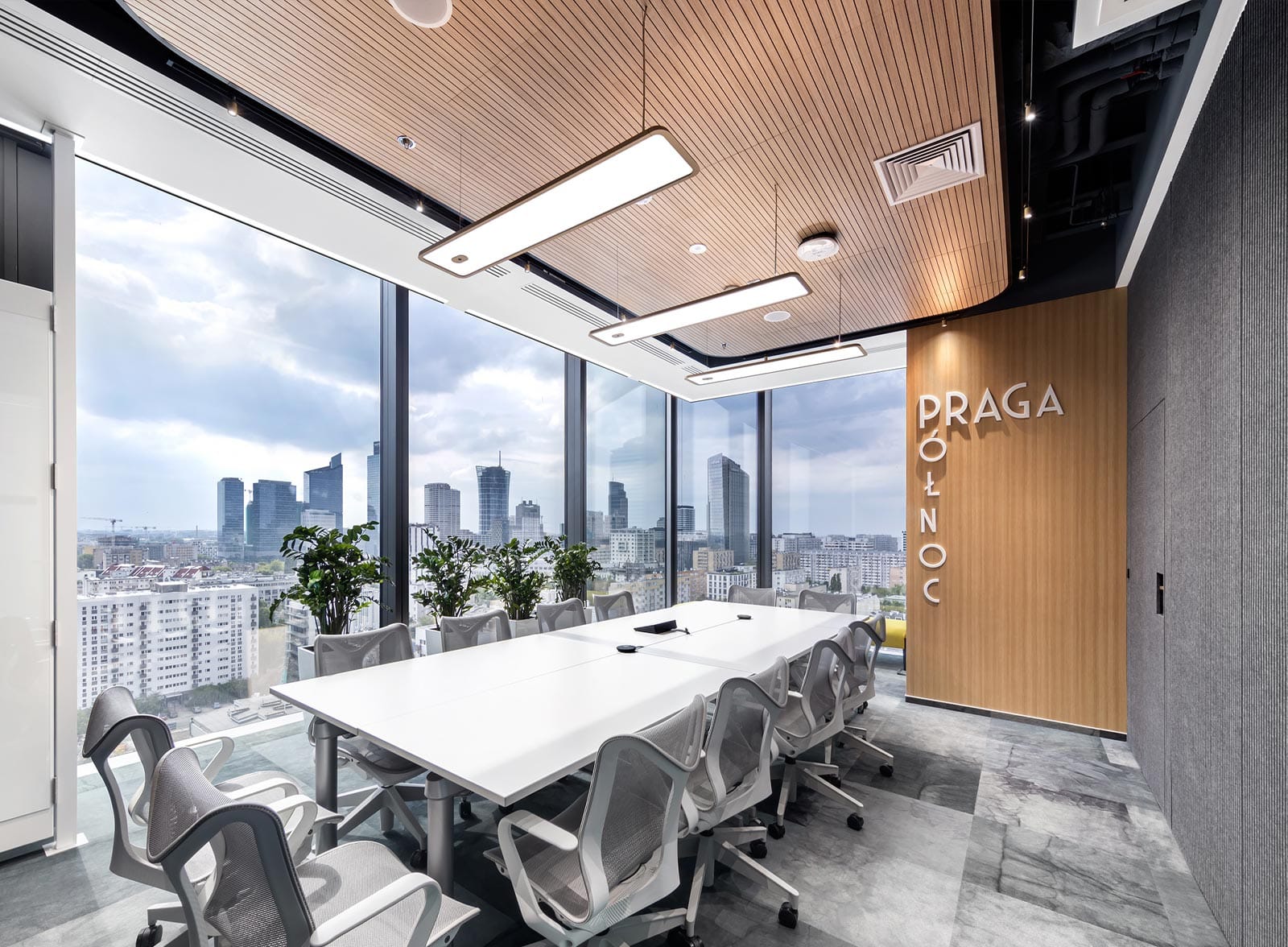
In the office sector, Ideacustic Standard 32 was installed at the Varso Place building in Warsaw, Poland, to control reverberation and improve acoustic comfort throughout the workspaces.
What to consider before implementing acoustic treatment
Before selecting acoustic panels, we recommend assessing the following factors:
- When the problem occurs: If noise becomes an issue only when the room is fully occupied, excessive reverberation is often the cause.
- Available surfaces: Ceilings, unobstructed walls and areas where acoustic treatment will not interfere with the functionality of the space.
- The interior design concept: Wood, coloured PET, textile finishes or discreet acoustic panels that blend seamlessly into the environment.
- Maintenance requirements: In hospitality spaces, easy-to-clean finishes are particularly important.
- Fire performance requirements: The reaction-to-fire classification required for the intended use of the premises.
With this information, it is possible to develop an acoustic solution that reduces noise levels without compromising the character or aesthetics of the space.
Would you like people to hold conversations in your space without raising their voices?
At Ideatec, we manufacture acoustic wall and ceiling panels in wood, PET, slotted and perforated MDF, and textile, specifically designed for restaurants, offices and high-occupancy spaces.
Contact our team and we will help you determine the acoustic treatment your space needs to reduce reverberation and break the Lombard effect cycle.

