What an acoustic panel is, how it absorbs sound, the types available based on material, and the situations where installing them is worthwhile.
Acoustic panels have become a common feature in offices, restaurants, classrooms, and homes.
They appear on ceilings and walls in a wide variety of colors and formats, almost always with the same promise: to make the space sound better.
That promise holds true, but it is worth understanding exactly what a panel does—and what it doesn't do—as well as the situations where installing one makes sense. That is what we will explore here.
What is an acoustic panel used for?
An acoustic panel absorbs part of the sound that reaches its surface instead of reflecting it back into the room. Its function is to reduce sound reflections within the space.
This translates into three specific effects. It reduces the reverberation time, so voices stop overlapping. It improves speech intelligibility, making it easier to understand the person speaking. And it reduces the perception of background noise because sound is no longer allowed to build up.
It is important to clarify what it does not do. An acoustic panel does not prevent sound from passing from one room to another: that depends on the construction of the partition, which is a different issue.
We explain this in detail in our article about the difference between soundproofing and acoustic treatment.
In other words: an acoustic panel improves how a room sounds from the inside, not what can be heard from outside.
How does it work?
An acoustic panel works by converting sound energy into a minimal amount of heat. There are two main mechanisms, and many systems combine both.
Porous absorption
This is the most widespread mechanism. The material has an open structure, with interconnected voids. When the sound wave enters, the air is forced to move through these openings, and friction dissipates part of its energy.
Fibrous materials and technical fabrics work in this way. Their performance depends mainly on thickness: the thicker the panel, the better it absorbs low frequencies.
Resonant absorption
This occurs in panels with perforations or slots installed with an air cavity behind them. The system behaves like a resonator: the air in the openings vibrates at a specific frequency and dissipates energy within that range.
This makes it possible to tune a panel so that it acts precisely where the problem occurs. Perforated or slotted wood panels, combined with an absorbent material on the back, work according to this principle.
How is sound absorption measured?
The reference value is the sound absorption coefficient, which ranges from 0 to 1. A value of 0 means that the surface reflects all the sound, while a value of 1 means that it reflects none of it.
Based on this coefficient, products are classified from A to E. A Class A panel absorbs virtually all the sound it receives, while a Class E panel provides very little absorption. This is the figure to look for in the technical data sheet and compare between systems.
If you want to review the fundamentals of reverberation and frequency, you can consult our article on the basic concepts of acoustics.
Types of acoustic panels according to material
The material determines the panel’s performance, finish and the context in which it is best suited.
Recycled polyester fibre
It is manufactured from recycled PET. It is lightweight, does not generate dust, can be cut to size and is available in a wide range of colours. It allows for suspended formats, wall panels and die-cut elements.
It is the basis of the Ideaflow family and systems such as the Islas and Baffles.
Wood
Wood is used in two formats. Slats installed over an absorbent backing, which provide a warm and continuous finish. And perforated or slotted boards, which work as resonators.
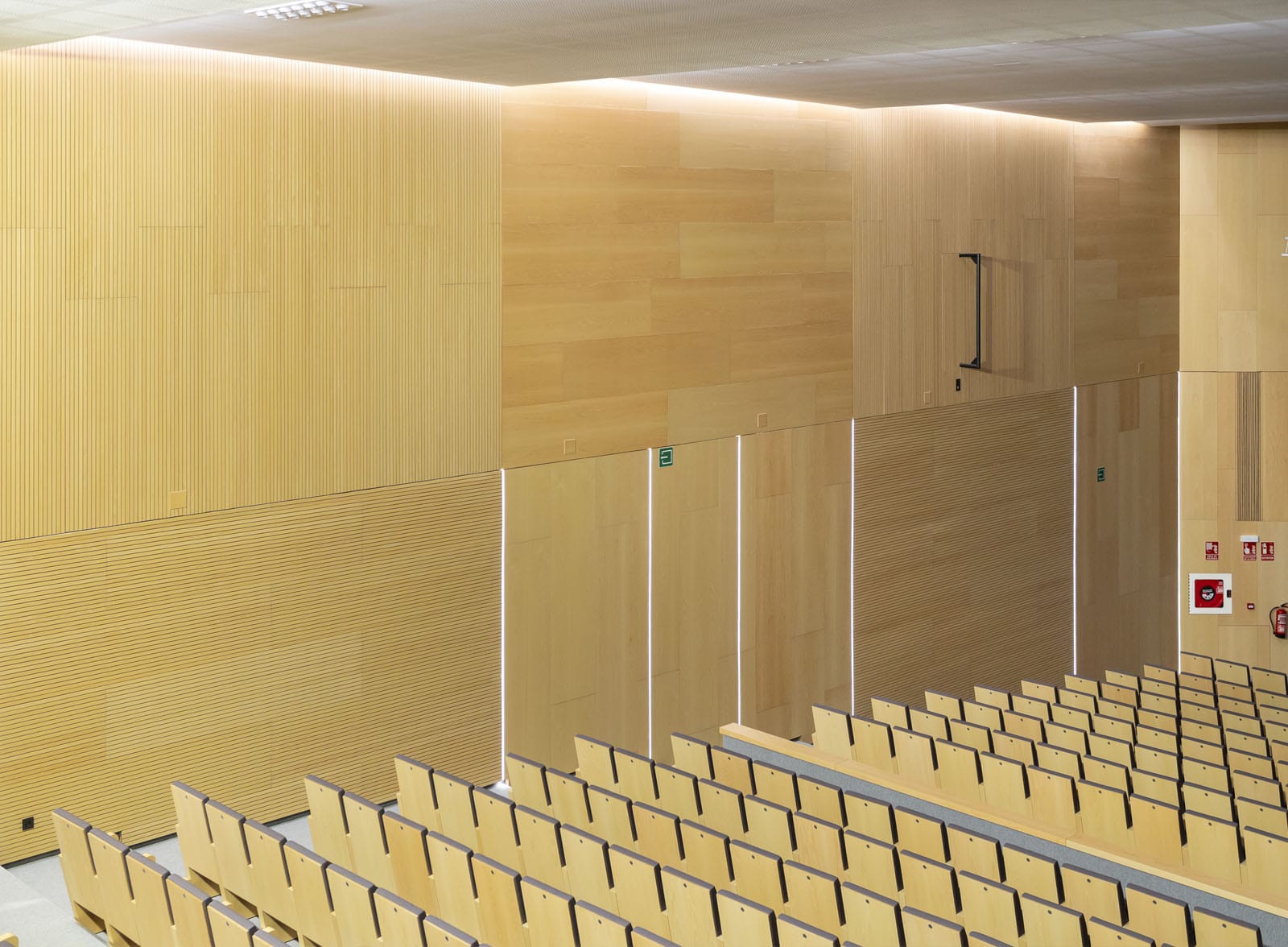
The Ideawood and Ideaperfo families use these formats. At the Almussafes Auditorium, the walls were treated with Idealux FL slats, combining sound absorption with a natural wood finish.
MDF board
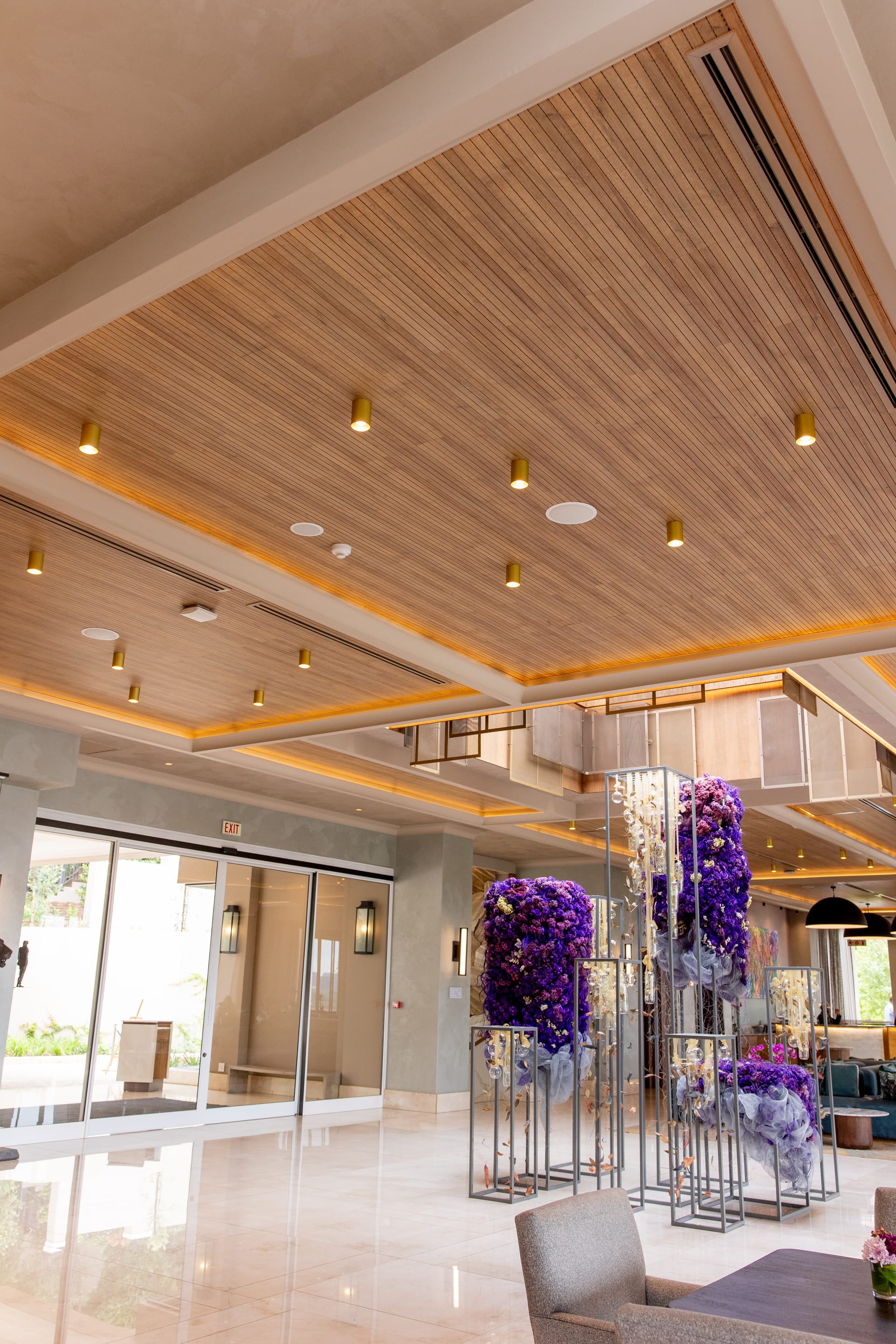
MDF allows large-format surfaces with a wide variety of finishes and straightforward installation. It is the basis of the Ideacustic family, with systems such as Standard 32, which was used at the Four Seasons Hotel in Johannesburg.
Textile
An absorbent core covered with technical fabric. It offers the greatest range of colour options and integrates particularly well when the panel needs to visually disappear or, conversely, become a decorative element.
When do you need acoustic panels?
There are some fairly clear signs. If it is difficult to follow a conversation at a distance of two or three metres, if voices seem to linger after someone stops speaking, or if you experience unexplained fatigue at the end of the day, there is likely a reverberation problem.
It is often even more noticeable during video calls than in person: the microphone picks up sound reflections, causing the voice to reach the other end with an echo.
There are also contexts where acoustic treatment is almost a necessity by definition. Open-plan workspaces, restaurants with hard surfaces, classrooms, glass-enclosed meeting rooms and high-ceilinged spaces naturally accumulate reverberation due to their geometry.
There is one situation, however, where acoustic panels are not the right solution: if the problem is hearing your neighbour or noise coming in from the street, panels will not solve it. In that case, the building enclosure needs to be addressed.
How many acoustic panels do you need and where should they be placed?
There is no universal rule, as this depends on the volume of the room, the materials already present and how the space is used. However, there are some useful starting points.
As a general guideline, in a conventional room, a significant proportion of the ceiling surface is usually treated, complemented with wall treatment if necessary to correct reflections between opposing surfaces.
Location is just as important as quantity. A panel placed where the problematic reflection does not reach will have little or no effect, regardless of how effective the material is. This is why, in projects of a certain scale, it is advisable to start with a measurement rather than an estimate.
Distributing the treated surface generally works better than concentrating it in a single area. It is also important not to overdo it: an over-treated room can feel dull and uncomfortable because the aim is not to eliminate reflected sound, but to control it.
Do you need acoustic panels for your project?
At Ideatec, we manufacture acoustic panels in recycled polyester, wood, MDF and textile, for both walls and ceilings. Each solution is adapted to the space, its use and the visual language of the project.
Consult with our team, and we will help you choose the system and quantity your space needs.

